Environmental Awareness
We endeavor to reduce the overall impact on our environment through education by promoting conscious awareness of sustainable production and consumption of goods. The resources of our planet are not limitless, and as we forge ahead into the second decade of this new century, we remain mindful of key concepts that will help keep bring us back in harmony with our beautiful blue/green earth, such as renewable energy, urban agriculture, social justice and systems resilience ~ to name only a few!

|

|
|

Looking for a Sustainable Community?
Join us at Transition Newton |
Another web site that helps underscore the severity of overuse of natural resources is the Global Footprint Network. From their web site:
"Humanity now requires the equivalent of 1.4 planets (1.6 planets in 2015) to support our lifestyles. The result is that our supply of natural resources -- like trees and fish -- continues to shrink, while our waste, primarily carbon dioxide, accumulates."
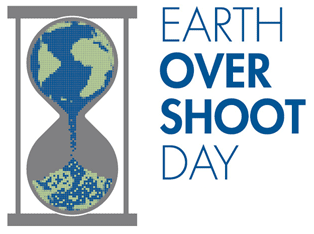
Similar to the IRS calculating "Tax Freedom Day", the Global Footprint Network calculates our Ecological Debt Day, or more commonly called "Earth Overshoot Day", thus establishing a worrisome milestone each year: the approximate day humanity will have used all the resources nature will generate in a given year. Below are some recent days pinpointed as "Earth Overshoot Day" - the day when humanity begins living beyond its ecological means. Currently, in 8 Months, Humanity Exhausts Earth's Ecological Budget for the Year:
2023: August 2
2022: July 28
2021: July 29
2020: August 22 (Covid)
2019: July 29
2018: August 1
2017: August 2
2016: August 8
2015: August 13
2014: August 19
2013: August 20
2012: August 22
2010: August 21 (nearly an entire month earlier!)
2009: September 25
2008: September 23
2003: September 22
1993: October 21
Click on the hourglass logo to the right for additional information.
"Earth Overshoot Day is an estimate, not an exact date. It’s not possible to determine with 100 percent accuracy the day we bust our ecological budget." (~ From the Earth Overshoot Day webpage)
2023: August 2
2022: July 28
2021: July 29
2020: August 22 (Covid)
2019: July 29
2018: August 1
2017: August 2
2016: August 8
2015: August 13
2014: August 19
2013: August 20
2012: August 22
2010: August 21 (nearly an entire month earlier!)
2009: September 25
2008: September 23
2003: September 22
1993: October 21
Click on the hourglass logo to the right for additional information.
"Earth Overshoot Day is an estimate, not an exact date. It’s not possible to determine with 100 percent accuracy the day we bust our ecological budget." (~ From the Earth Overshoot Day webpage)

Transition Newton, located in Newton, NJ, is the NJ chapter of the global Transition Movement founded in Ireland. Originally called Transition Towns, it is a movement that was founded in Kinsale, Ireland and Totnes, England by environmentalist Rob Hopkins during 2005 and 2006. The aim of the project is to equip communities for the dual challenges of climate change and peak oil. The movement currently has member communities in over 34 countries worldwide. Transition Newton has added a third challenge - Sustainability - to their goals. They meet the third Thursday of each month, with additional workshops and informational seminars sprinkled throughout the calendar. If you are interested in building community with like-minded, forward-thinking individuals who are concerned about the rapid climate changes, economic stability and dependence on foreign oil, be sure to check them out at http://transitionnewton.com/.
Willow Moon Herbals is a proud Affiliate of iGiveTrees, a 'global cooling' project that supports the people who have taken the initiative to sustainably harvest seeds, organically grown trees and supply organizations who teach subsistence farm families how to replant a rainforest. The Atlantic Forest in Brazil is already 93% gone. iGiveTrees is a social enterprise giving native trees to slash/burn farm families who are replanting the most endangered and diverse rainforest on earth.
Did you know that planting trees in the tropics, where they grow fast and have unlimited space to stretch out, makes a bigger impact toward reversing global warming? They grow to full size faster and sink more carbon there. As a global community, we can help them plant trees on millions of acres of deforested land for small amounts of money that support rainforest communities to become stewards of the planet.
Started by Alana Lea, who has been called a “a real world Lorax“, she discovered that planting trees in the rainforest where she was born, was the easiest way she could find to back her beliefs with her money. So she started doing just that: planting trees in the Atlantic Rainforest of Brazil, with the help of the people whose faces you can see and read about on her website: www.igivetrees.com along with several organizations including Kids for Environmental & Social Action. Together, they were able to give 4,194 trees back to the rainforest last year, while supporting simple people who felt invisible to the outside world.
Take a stand for a rural association of organic tree growers by supporting their local efforts on behalf of global sustainability. For more information, or if you would like to give the gift of a tree, go here: www.igivetrees.com
Did you know that planting trees in the tropics, where they grow fast and have unlimited space to stretch out, makes a bigger impact toward reversing global warming? They grow to full size faster and sink more carbon there. As a global community, we can help them plant trees on millions of acres of deforested land for small amounts of money that support rainforest communities to become stewards of the planet.
Started by Alana Lea, who has been called a “a real world Lorax“, she discovered that planting trees in the rainforest where she was born, was the easiest way she could find to back her beliefs with her money. So she started doing just that: planting trees in the Atlantic Rainforest of Brazil, with the help of the people whose faces you can see and read about on her website: www.igivetrees.com along with several organizations including Kids for Environmental & Social Action. Together, they were able to give 4,194 trees back to the rainforest last year, while supporting simple people who felt invisible to the outside world.
Take a stand for a rural association of organic tree growers by supporting their local efforts on behalf of global sustainability. For more information, or if you would like to give the gift of a tree, go here: www.igivetrees.com
"I speak for the trees, for the trees have no tongues…” The Lorax
Professional Services |
po box 147
schooley's mtn, nj 07870 201/650-7500 
|



Two convenient locations. Hours by Appointment only, with remote, tele-health consultations available
1635 US Highway 206, Chester, NJ 07930
Little Silver, NJ location
1635 US Highway 206, Chester, NJ 07930
Little Silver, NJ location
"Le vrai voyage de la découverte consiste pas en cherchant de nouveaux paysages, mais en ayant de nouveaux yeux."
“The real voyage of discovery is not in seeking new landscapes, but in having new eyes” ~Marcel Proust
Copyright © 2009 - 2024 ♦ Willow Moon Herbals, LLC ♦ All rights reserved
“The real voyage of discovery is not in seeking new landscapes, but in having new eyes” ~Marcel Proust
Copyright © 2009 - 2024 ♦ Willow Moon Herbals, LLC ♦ All rights reserved